Europe has a world-class research and innovation ecosystem, but turning scientific excellence into successful products and services remains a challenge. This is also true in the forest bioeconomy, where bringing new forest and bio-based innovations to market often requires substantial investment in physical infrastructure and involves high technological and market risks.
As a result, many innovations struggle to cross the so-called valley of death, a phase between early-stage R&D and commercial viability, where limited public funding and high private investment risks can hinder scale-up and commercialisation.
However, this is not a challenge for the forest bioeconomy alone.
European Innovation Act
In September 2026, the European Commission adopted the European Innovation Act. The proposed Regulation aims to strengthen the Single Market for innovation by tackling two barriers to commercial success: R&D procurement and intellectual property valuation.
The Act proposes a harmonised EU framework for R&D procurement to strengthen public procurement as a driver of innovation. The framework aims to create greater legal clarity and a critical mass for investment in cutting-edge solutions, and to help new technologies reach the market faster across borders.
It also proposes an EU-wide framework for intellectual property valuation, enabling access to finance. The framework aims to support IP-backed finance and create an EU-wide marketplace for commercialising IP assets.
The European Commission identifies a broader challenge: structural barriers in the Single Market can slow down the journey from laboratory to market, from start-up to scale-up, and from invention to industrial strength. In addition, it remains overly dependent on suppliers outside the Union to buy innovative products and services.
EFI Bioregions’ work
EFI Bioregions has explored the challenges innovators face through a series of reports and activities, including events, open challenges, and workshops.
It identified barriers, including complicated regulation, fragmented ownership, market failures, uncertainty and risk, limited access to finance, reduced liquidity, and low returns.
The key messages reinforce the need for an innovation ecosystem that can help promising ideas become investment-ready and commercially viable. The European Innovation Act brings this aspect to innovation finance.
Create a supportive financial framework for scale-up
Maximise the impact of open-access scaling facilities
Build strategic partnerships to catalyse scaling up
Ensure coherent regulation to enable market development
Invest in capacity building and training to create cross-sectoral profiles.
These recommendations highlight that successful scale-up requires more than funding research. Finance, infrastructure, partnerships, regulation, skills and market conditions all need to come together.
EFI Bioregions’ work on green public procurement explores how public authorities can use their purchasing power to create demand for bio-based solutions.
This connects with the European Innovation Act’s proposed framework for R&D procurement. It can help create the conditions for innovative solutions to be tested, adopted and brought to market.
Explore our reports
To learn more about scaling forest and bio-based innovation, overcoming investment barriers and using public procurement to support the bioeconomy, download our reports and follow EFI Bioregions on LinkedIn to stay up to date on the forest bioeconomy and what European regions are doing to move the green transition forward.
The Government of Catalonia has joined the Board of the BETA Foundation (UVic-UCC), strengthening its commitment to circular bioeconomy, sustainable agri-food systems and ecological transition. The agreement establishes a new cross-departmental collaboration between the areas of agriculture, environmental transition and research, backed by €875,000 in funding for 2026.
A key objective is to accelerate innovation and knowledge transfer in nutrient circularity – promoting the conversion of organic waste streams into high-value biofertilisers and reducing dependence on imported fertilisers – while further supporting applied research and industrial demonstration capacities in Catalonia, including the Centre’s new facilities at the FERTIEBRO site in Soses.
As a member of the EFI Bioregions, Catalonia continues to build the applied research and cross-sector partnerships that underpin its regional bioeconomy strategy, and this new governance role at BETA is a further step in that direction.
To move from successful demonstration to commercial deployment, innovative bio-based solutions need the right partners, significant investment but also regional support. European funding programmes play an important role in supporting research and innovation and in scaling up the bioeconomy sector and bio-based innovations. But many promising projects need follow-up investment, regional support and links to other funding sources to reach deployment.
In this interview, Virginia Puzzolo, Head of Programme at the Circular Bio-based Europe Joint Undertaking (CBE JU), explains why stronger collaboration between European programmes and regional authorities can help innovative companies take the next step. Watch the full interview below or explore the key questions and answers.
By clicking “Play”, content from YouTube will be loaded. This means that your personal data (such as your IP address) may be transmitted to YouTube and that YouTube may set cookies on your device. You can find more information in YouTube’s Privacy Policy.
Why are regions important for scaling up bio-based innovations?
Each year, CBE JU receives more proposals than it can fund within the available budget. So high-quality proposals submitted but not funded by the CBE could benefit from other funding mechanism.
In particular, for projects aiming at developing first-of-their-kind industrial biorefineries, regional funding can be vital to ensure that promising projects are not lost, while allowing regions to retain investment and strengthen their local bioeconomy.
“Regions can be the next step to ensure that these excellent projects are not lost.”
What happens after a project successfully demonstrates its technology?
Over the past decade, CBE JU has supported numerous projects that have successfully demonstrated new bio-based technologies and production processes.
However, demonstration is only one step of the journey. Many projects still need support to deploy industrial-scale production, particularly in areas such as bio-based chemicals, materials and feed ingredients.
Many of these innovations are led by small and medium-sized enterprises that often lack the investment capacity needed to commercialise their technologies.
Why are partnerships between Europe and regions important?
Creating the first industrial production facility often requires investments far beyond the capacity of a single company, especially if this is an SME.
Virginia Puzzolo notes that these first-of-its-kind biorefinery projects can require investments worth hundreds of millions of euros. Industry typically contributes part of the financing, while additional public and private funding is needed to complete the “financing puzzle.”
Regional authorities can play an important role in bringing together these different funding mechanisms and supporting companies through the scale-up process.
How can regions support projects and companies?
Regions can provide direct financial support for industrial innovation or offer indirect support by:
From EFI Bioregions’ prospect, this agreement strengthens also our role in accelerating the forest bioeconomy, bio-based innovations and uniting key stakeholders.
North Rhine-Westphalia (NRW), Germany, has published its 2026 Bioeconomy Strategy, positioning the region as a future leader in sustainable, bio-based industrial transformation.
The North Rhine-Westphalia Bioeconomy Strategy 2026 was developed with input from the NRW Bioeconomy Council and sets out a vision for NRW to become an internationally leading bioeconomy location by 2045.
Vision of the North Rhine-Westphalia Bioeconomy Strategy 2026
The bioeconomy is a key future sector for North Rhine-Westphalia. It increases the economy’s resilience to crises, supply chain disruptions, raw material shortages, and the consequences of climate change. In the long term, the bioeconomy secures competitiveness, economic, technological, and resource sovereignty, as well as societal prosperity – economically, ecologically, and socially.
The vision is an NRW economy where bio-based products are produced and exported globally, research and industry co-develop solutions from lab to market, and regions become demonstration and scaling spaces for bioeconomy innovation.
Guiding principles and action areas
Four guiding principles shape the approach:
actively engaging a broad range of stakeholders;
activating regional strengths;
ensuring horizontal integration across government ministries; and
aligning vertically with EU, national, and local levels.
Six action areas define where the state government will focus:
unlocking primary biomass from agriculture and forestry;
mobilising secondary bio-based raw materials through circular approaches;
advancing research and innovation;
supporting market and product development;
improving the regulatory environment; and
expanding skills and knowledge in the bioeconomy.
Securing multifunctional forest management
The state government supports the adaptation process in forestry through information, advice and project funding in order to permanently secure multifunctional forest management in North Rhine-Westphalia.
It highlights NRW’s goals to invest in new funding programmes and to support existing ones to cover integrated forest management, forest conversion, ecosystem services, digitalisation, and other new business models.
Forest monitoring will be strengthened, as will support for forest inventories, forest condition surveys and soil condition surveys.
Interregional networking and cooperation are other measures pursued by the region, fostering collaboration with European networks such as the EFI Bioregions.
Content: North Rhine-Westphalia Bioeconomy Strategy 2026: Towards a Resilient Future (original title in German: Bioökonomie-Strategie Nordrhein-Westfalen 2026: Auf dem Weg in eine resiliente Zukunft)
On 11–13 May 2026, join ERIAFF at its 12th Annual Conference in Amsterdam, the Netherlands. This year’s theme is Regional agri-food & forestry systems: balancing the Economic, Ecologic, Environmental and Social innovations.
Participants are welcome to join us for an inspiring programme with interesting speakers, innovative breakout sessions and exciting work visits.
If you have any questions, please contact m.tazelaar@pzh.nl.
On 13–14 May, join this year’s ERIAFF Conference. Explore the theme of Regional agri-food & forestry systems: balancing the Economic, Ecological, Environmental and Social innovations. An inspiring programme with interesting speakers, innovative breakout sessions and exciting work visits awaits you.
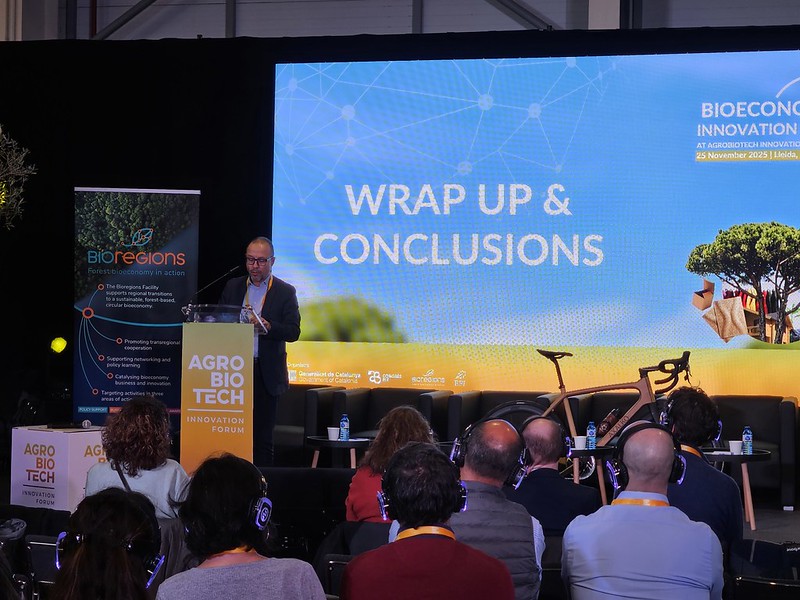
On 25 November, the Bioeconomy Innovation Day 2025, hosted at the AgroBioTech Forum in Lleida, Catalonia, Spain, brought together innovators, industry leaders, investors, and researchers to explore how bio-based materials and circular solutions can drive the biologisation of high-impact sectors such as construction, manufacturing, cosmetics, and interior design.
The programme combined high-level keynotes, sector-focused pitch sessions, and real-time investor feedback after each pitch, creating a dynamic exchange between vision, innovation, and finance.
Opening the event, EFI’s Inazio Martinez de Arano challenged participants with a central question:
“How can we use our existing biomass to deliver both environmental benefits and social value?”
Opening keynotes: regional vision and support for the bioeconomy
Building on this challenge, the opening keynotes set the stage with a strong regional vision for the bioeconomy. Cristina Massot, Secretary General of the Department of Agriculture, Livestock, Fisheries and Food at the Government of Catalonia, outlined how the region is embedding the bioeconomy into long-term economic planning, describing it as “a driving force for the Catalan economy.”
She presented the three-year Bioeconomy Action Plan 2025–2027, equipped with a €269 million budget and 44 actions that prioritise improved forest management, the valorisation of organic and agri-food side-streams, and the creation of resilient agroforestry landscapes. She emphasised that this is now a whole-of-government commitment:
“This is serious. Not only for our department, but also for the Government of Catalonia.”
The second keynote, delivered by BioHubCat and Simbiosy, highlighted the importance of strengthening Catalonia’s support ecosystem for bioeconomy innovation. BioHubCat, Catalonia’s coordination hub for the circular bioeconomy, connects companies with public services, fills system gaps, and helps start-ups overcome technical and administrative challenges.
“Our role is on the ground, helping each company step by step so they can become competitive,” they noted.
Simbiosy, a consultancy specialising in industrial symbiosis and circular economy strategies, stressed that bioeconomy projects are inherently systemic and require collaboration across multiple actors.
They introduced the BioBoost accelerator, which reduces investment risk and supports start-ups with legal, financial, technological, and facilitation services.
“Every systemic project needs facilitation to actually happen,” they emphasised.
Investor panel: market opportunities and the realities of scaling
With a strong regional vision established, the discussion shifted to the financial realities of scaling bio-based innovation. The investor session provided a candid look at the opportunities and challenges facing bio-based ventures.
Michael Brandkamp of the European Circular Bioeconomy Fund stressed that “the bioeconomy is not just an option; it is a must”, driven by shifting consumer demand, policy pressure and climate-related risks.
However, he highlighted key challenges for start-ups, including competition for feedstocks, complex R&D, and the need to validate real customer demand.
“Most innovations fail not because of technology but because they solve a problem nobody has validated,” he remarked.
Jan Debets from META Group emphasised the challenges faced by research-driven ventures, noting that university spin-outs are “high-risk because researchers often fall in love with their science and forget about the customer”.
As a research accelerator, META focuses on helping science-based start-ups navigate this gap between technology and market needs. Debets also highlighted that, as the bio-based sector matures, investors are increasingly open to backing these ventures.
Session 1: Bio-based construction
With these themes in mind, the opening pitch session demonstrated practical ways to apply bio-based construction. It began with a keynote from the Institute for Advanced Architecture of Catalonia (IAAC), where Olly Needham presented their work on full-cycle timber construction.
As a “laboratory for self-sufficient habitat”, they demonstrated how forest stewardship and architecture can be deeply intertwined by managing pine forests, selectively harvesting trees, and ensuring full traceability from woodland to building.
“Traceability is essential if we want to understand the real impact of the materials we use,” he noted, highlighting how their approach connects local forests directly to sustainable buildings.
This keynote was followed by four innovation pitches that highlighted a diverse set of bio-based construction solutions.
ParaStruct presented a carbon-sink subfloor made from mineral binders and plant residues, offering a cost-competitive alternative to cement.
Sebastia showed how locally sourced Pyrenean timber can be turned into cross-laminated timber panels that store carbon effectively and support improved forest management.
RMT Insulation introduced wool- and cotton-based materials for building insulation and green roofs, combining affordability with biodegradability.
Czech University of Life Sciences Prague demonstrated mycelium-based panels made from recycled wood, which provide strong insulation and even help break down contaminants.
Together, the pitches showed how biological materials can advance low-carbon construction while facing shared hurdles such as certification, feedstock availability and scaling.
Session 2: A bio-based way of life
Attention shifted to a bio-based way of life, highlighting innovations that bring sustainability into daily routines and consumer choices. Ricard Armengol, CEO at Provital, opened the second session by unpacking fast-evolving trends in the cosmetics sector, where well-being, scientific evidence, and sustainability increasingly shape consumer expectations. Provital, a global cosmetics ingredient manufacturer based in Catalonia, specialising in natural, sustainable solutions for skin and hair care, stressed that today’s consumers are highly informed and demand transparency: products must not only claim benefits but demonstrate the science behind them. Sustainability, once a niche, is now a dominant driver of innovation.
Provital also highlighted a critical challenge for ingredient suppliers: branding is no longer optional. Even in a B2B context, where raw materials have a limited market, strong branding is essential to avoid being easily substituted.
“If you don’t build a brand, someone else will,” Armengol warned, urging companies to know their customers deeply and tailor products to real needs in a fragmented market.
The pitches showcased how bio-based innovations are entering lifestyle, beauty, and design markets:
Roka Furadada demonstrated how lignin, a widely available forestry by-product, can be upcycled into multifunctional cosmetic actives for skin and hair care, replacing fossil-derived ingredients.
Boreal Bioproducts presented its water-based, zero-waste process for extracting biochemicals from sawdust and bark, producing lignin, tannins, and sugars for applications ranging from cosmetics to animal nutrition.
Bagaceira introduced an acoustic panel system made from sugarcane bagasse, combining aesthetic design with high sound absorption and carbon storage.
All innovators emphasised the circular use of residues, from forestry side-streams to sugarcane by-products, and the growing demand for high-performance, sustainable alternatives in consumer-facing sectors.
Session 3: Bio-based solutions for sustainable manufacturing
The day concluded with a session on manufacturing, the backbone of industrial transformation. A keynote was given by Maria Dolors Nuñez, Head of Technology Opportunity Analysis at ACCIÓ, Catalonia’s agency for business competitiveness and innovation, emphasising that biomaterials are not just part of the solution; they are key enablers for building more sustainable and competitive manufacturing systems.
“Bio-based materials redefine how we design, produce, and reuse,” she noted, positioning them as drivers of innovation and industrial resilience.
Catalonia’s strong ecosystem, spanning research centres, universities, companies, clusters, and institutional support, offers a fertile ground for emerging value chains and industrial symbiosis. However, ACCIÓ stressed that scaling up, securing investment, and harmonising standards remain critical challenges. Linking research with industry and fostering hybrid knowledge across sectors is essential to unlock these opportunities and make Catalonia a European leader in the bioeconomy.
This final session featured innovations in advanced composites and circular materials for mobility, wind energy and urban infrastructures:
Voodin Blade Technology showcased wooden wind turbine blades made from laminated veneer lumber, offering lower cost and carbon impact with a licensing model for scale-up.
Alcorke Playground presented flooring made from upcycled cork stoppers, turning industry waste into renewable playground materials.
Advanced BioComposites (ABC) introduced lightweight biocomposites as strong as aluminium for buses, trains and industrial components, providing recyclable, low-carbon alternatives.
These pitches signal new pathways for renewable materials to reshape manufacturing and reduce environmental impact.
Concluding remarks
The Bioeconomy Innovation Day 2025 underscored a clear message: bio-based materials are no longer niche; they are strategic enablers of sustainability, competitiveness and resilience.
Across keynotes and pitches, speakers highlighted the need for systemic collaboration, strong branding, and new business models to scale innovation. Investors stressed that while policy and consumer trends create momentum, success depends on proving real market demand and bridging the gap between research and commercial viability.
Closing the event, Salvador Samitier of the Department of Agriculture, Livestock, Fisheries and Food at the Government of Catalonia, reminded participants that the bioeconomy is not just a sector but a vision for how society can live with nature. It has the potential to offer economic opportunities, particularly for rural areas, while supporting ecosystem restoration and resilience.
Read all factsheets
Advanced BioComposites (ABC) is a technology company developing sustainable composite materials for industrial manufacturing.
Alcorke Playground is a circular economy project led by the Institut Català del Suro Foundation that gives a second life to used natural cork stoppers.
Voodin Blade Technology develops wind turbine blades using LVL, an alternative to conventional fibreglass and carbon-composite blades.
Roka Furadada specialises in the development of innovative molecules and active ingredients for use in cosmetics and personal care.
Bagaceira develops innovative bio-based materials using sugarcane bagasse, the fibrous residue from sugar and alcohol production.
Boreal Bioproducts is a biorefinery startup that produces bio-based chemical extracts from forest-industry side streams such as sawdust and bark.
RMT Insulation develops natural insulation solutions using renewable natural fibres as alternatives to synthetic materials.
This innovation focuses on producing mycelium-based biocomposite (MBB) insulation panels using waste wood as the primary feedstock.
Sebastia is a timber construction company with roots in a family wood-working tradition dating back to 1954.
ParaStruct works to decarbonise the construction industry by applying circular economy principles to building materials.
Explore the innovations presented at the Bioeconomy Innovation Day 2025 in a factsheet format.
Pitch Perfect and Boost the European Bioeconomy 2025
On 24–25 November, join the Pitch Perfect and Boost the European Bioeconomy 2025 in Brussels, Belgium. This event is co-organised by Pilots4U, Bio Base Europe Pilot Plant, The ProteInn, Brabantse Ontwikkelings Maatschappij (BOM) Catalysing Change.
This is a two-day event featuring intense cross-border and cross-sectoral pitching, matchmaking, and networking, to link industry to innovative (bio-based) technologies, innovators to investors, and creating new partnerships for the future and the further development of innovative, cross-border, and cross-sectoral industrial value chains in the biobased economy.
On 26 May 2025, the Bioregions Facility and the Wald und Holz North Rhine-Westphalia co-organised the “Towards a European wood start-up ecosystem: lessons learned from across European regions” networking session at the LIGNA Fair in Hanover, Germany.
The session explored how to better support forest and wood-based start-ups by learning from five initiatives across European regions: Woodknowledge Wales, Zentrum Holz, LaWoodTech (Xylofutur), VDMA Startup Machine, and the Bioregions Facility.
The presentations were followed by a roundtable with the presenters to seek opportunities and collaborations, during which participants asked questions and shared their own experiences.
Explore our photo gallery.
Photos: Courtesy of PK-Media Consulting GmbH / Wald und Holz NRW
On 1 July 2025, join FIRE-RES at the Spanish FIRE-RES Innovation Day at Casa Convalescència, Universitat Autònoma de Barcelona (UAB) in Barcelona, Spain. The event brings together experts and stakeholders from across Europe to address the growing challenges of wildfire management.
The Innovation Day will feature dynamic sessions focused on high-impact strategies for wildfire preparedness, response, and mitigation. A central component of the programme will include a workshop dedicated to the current and future applications of data in wildfire innovation, highlighting how information-driven approaches shape the future of crisis management.
Attendees will also have the opportunity to engage with a showcase of cutting-edge tools developed to support wildfire management, participate in interactive workstations and engage in partnership-building activities.
The event is expected to attract diverse participants, including researchers, policymakers, emergency response professionals, and technology developers. Organisers anticipate engaging discussions and collaborative exchanges that will contribute to advancing innovative approaches to wildfire challenges across Europe.
Forest-based industries have the opportunity – and the responsibility – to lead transformative change in how we produce, consume, and regenerate materials within the European bioeconomy. Wood construction, textiles, packaging and green chemistry are examples of new wood-based markets that could increase the revenues of forest industries in European countries ranging from 18 to 75 billion euros per year by 2030.
But they also face significant challenges to remain competitive in a rapidly changing global market. Therefore, forests must be managed to be more resilient and multifunctional, while industries must keep advancing in material efficiency, circularity, and the development of high-added-value products.
Innovation is key to this transformation, but the pace of innovation must accelerate. But how?Collaborative partnerships, targeted policy incentives, and an innovation mindset across the sector, along with identifying, connecting, and supporting start-ups, can bring fresh ideas and disruptive solutions.
This session explores how to better support forest and wood-based start-ups by learning from successful initiatives across European regions. The aim is to share lessons learned, identify best practices and concrete collaboration opportunities to unlock the potential of innovation – and ensure the sustainability, resilience, and competitiveness of Europe’s forests and forest-based industries.
Everyone attending the fair is welcome to participate in our session. If you do not have a ticket for LIGNA and would like to join us on 26 May, please email us at bioregions @ efi.int, and we will send you a complimentary ticket.
Towards a European wood start-up ecosystem: lessons learned from across European regions
On 26 May 2025 from 16:00 to 17:30 CEST, join us for the “Towards a European wood start-up ecosystem: lessons learned from across European regions” session at LIGNA 2025 in Hanover, Germany.
This session, organised by the Bioregions Facility, Wald & Holz of North Rhine-Westphalia, and the European Forest Institute, explores how to better support forest and wood-based start-ups by learning from successful initiatives across European regions.
The aim is to share lessons learned, identify best practices and concrete collaboration opportunities to unlock the potential of innovation – and ensure the sustainability, resilience, and competitiveness of Europe’s forests and forest-based industries.
Everyone attending the fair is welcome to participate in our session. If you do not have a ticket for LIGNA 2025 and would like to join us on 26 May, please email us at bioregions@efi.int, and we’ll send you a complimentary ticket.
Tentative Programme
Last update: 29 April | Time in CEST
16:00 | Welcome words
16:10 | Brief presentations by initiatives supporting forest/wood innovation:
Woodknowledge Wales: Christiane Lellig, Regenerative Development at Woodknowledge Wales
Zentrum Holz: Lukas Emmerich, Wood sciences and cluster manager at Landesbetrieb Wald und Holz North Rhine-Westphalia
LaWoodTech: Claudia Antoniotti, European mission manager at Xylofutur
We use cookies to optimize our website and our service.
Funcional
Always active
The technical storage or access is strictly necessary for the legitimate purpose of enabling the use of a specific service explicitly requested by the subscriber or user, or for the sole purpose of carrying out the transmission of a communication over an electronic communications network.
Preferences
The technical storage or access is necessary for the legitimate purpose of storing preferences that are not requested by the subscriber or user.
Statistics
The technical storage or access that is used exclusively for statistical purposes.The technical storage or access that is used exclusively for anonymous statistical purposes. Without a subpoena, voluntary compliance on the part of your Internet Service Provider, or additional records from a third party, information stored or retrieved for this purpose alone cannot usually be used to identify you.
Marketing
The technical storage or access is required to create user profiles to send advertising, or to track the user on a website or across several websites for similar marketing purposes.