The Government of Catalonia has joined the Board of the BETA Foundation (UVic-UCC), strengthening its commitment to circular bioeconomy, sustainable agri-food systems and ecological transition. The agreement establishes a new cross-departmental collaboration between the areas of agriculture, environmental transition and research, backed by €875,000 in funding for 2026.
A key objective is to accelerate innovation and knowledge transfer in nutrient circularity – promoting the conversion of organic waste streams into high-value biofertilisers and reducing dependence on imported fertilisers – while further supporting applied research and industrial demonstration capacities in Catalonia, including the Centre’s new facilities at the FERTIEBRO site in Soses.
As a member of the EFI Bioregions, Catalonia continues to build the applied research and cross-sector partnerships that underpin its regional bioeconomy strategy, and this new governance role at BETA is a further step in that direction.
In this sense, sustainable forest management acts directly on 65% of the Catalan territory and is a key element in guaranteeing the safety of people, the protection of the territory, the preservation of the natural environment and the development of the rural environment, in a context marked by the growing impact of the climate crisis.
In addition, the objectives of the Strategy foresee an increase of 36.8 million euros in investment, which consolidates sustainable forest management as a structural public policy for the country, aligned with people’s safety, fire prevention and rural development.
The new sustainable forestry strategy employs a prevention model based on three levels of intervention proposed for the short, medium and long term. The first is the protection of inhabited areas through protective strips and preventive infrastructure in urban-forest interfaces. In February, the Department opened a call for 2 million euros for local entities to draft forest fire prevention plans (PPI) and delimitation plans (PD), with the call scheduled to be renewed annually. The second level is the strategic management of forest massifs, with the consolidation of Priority Protection Perimeters (PPPs) as key planning instruments. The third is the definition of 14 fire containment axes, designed to limit the spread of large fires between massifs and improve the safety of the population and emergency services. This approach makes it possible to anticipate extreme fire scenarios and reduce the intensity and capacity for spread of fires, enabling a safer and more effective operational response in the short, medium and long term.
The Sustainable Forest Management Strategy incorporates, at the proposal of the Catalan Fire Brigade, what are known as fire containment axes as new strategic prevention infrastructures, aimed at limiting the spread of large forest fires between massifs and improving the safety of the population and emergency services. These axes act through the forestry and agroforestry management of wide, continuous strips to modify fire behaviour in extreme fire conditions and facilitate containment and extinguishing tasks.
Thus, in Catalonia, 14 lockdown axes have been demarcated, covering more than 223,000 hectares and protecting more than 872,550 people. Its deployment will be carried out progressively, prioritising the most strategic sections, and complementing the protection strips of inhabited areas and the management of forest massifs: A-2, Berga – Alp, C-25, Cardener, Conca Tremp – Segre, Empordà, Gironès – Ardenya – Gavarres, La Bisbal del Penedès – Argençola, Lladurs – Biosca, Montsec, Montseny – Montnegre, Priorat – Prades, Segre – Rialb, Vall de l’Ebre.
Acting on 34,194 hectares, they could protect 2,121,630 hectares of forest. Priority will initially be given to 5 containment axes that the Fire Department has identified as priorities after assessing the potential protected area and the population to be safeguarded.
The axes with the highest degree of efficiency are: Igualada-Martorell-Sta.Coloma de Cervelló, Perafita-Manresa, Girona-Celrà, Argentona-La Roca and Rasquera-Perelló. To date, works worth €2.85 million have been contracted, and work has started on 700 hectares. These 5 axes increase protection across 666,000 hectares, where 531,000 people live. Work will begin imminently in the Igualada and El Perelló areas of the Terres de l’Ebre.
In addition, the strategy is committed to professionalising and modernising the forestry sector, promoting generational change, promoting mechanisation, promoting extensive livestock farming as a tool for managing the territory, and promoting green public procurement, using wood and bioproducts of forest origin in building and public works. The initiative is aligned with the future General Forest Policy Plan of Catalonia and with other strategies in the field of biodiversity, nature restoration and land management.
Originally published on the CTFC website in Catalan.
The Centre for Forest Science and Technology of Catalonia (CTFC) has published a new manual on the sustainable management of the biological uprooting of forest species with decomposing fungi, prepared within the framework of the DESCOMPFONGS demonstration action, an activity co-financed by the European Union through intervention 7201 of the Strategic Plan of the Common Agricultural Policy (CAP) 2023-2027. The initiative addresses the need for alternatives to conventional strain management techniques in poplar plantations, which disturb soils and aquifers and affect local biodiversity.
After using wood from a poplar plantation, it is necessary to control stump regrowth. Traditional management involves the use of heavy machinery or chemicals, with negative effects on soil, water and ecosystems. For this reason, decomposers represent a naturalalternative: they are organisms capable of biologically degrading wood, thereby reducing reliance on aggressive mechanical techniques and chemicals.
The manual includes the methodology used and the results obtained from several experimental plots at the Escarp i Serós Farm, where this management technique has been tested. The document is available in digital format on the CTFC website and is aimed at technicians, forest managers and plantation owners who want to adopt more sustainable, environmentally friendly management practices.
Which fungal species are suitable for stump degradation
Practical application methods in the field
Potential environmental benefits and management considerations
Introduction
Fungi are organisms present in all ecosystems that fulfil a series of fundamental roles in the functioning of natural systems. Among them, we find mycorrhiza-forming species, which establish mutualistic associations with the roots of most woody plant species and are important actors in the carbon, nitrogen and phosphorus cycle in the soil.
On the other hand, there are parasitic species that live at the expense of other plant species, obtaining carbon from leaves, trunks and roots. Some of these species can cause serious diseases in trees, altering forest dynamics and influencing tree regeneration. The third functional group is saprophytic fungi, which decompose dead organic matter, such as bark, dead trunks, leaf litter or humus. These fungi play an essential role in the degradation of biomass and in the recycling of nutrients within forest ecosystems.
It is important to note that the three roles mentioned are not always static; some species can transition between them. Specifically, some mycorrhizal species, such as those of the genus Suillus, can degrade organic matter, while others, usually parasitic, can continue to degrade their host tree once it dies and, therefore, act as saprophytes. Furthermore, some species can even alternate between different strategies depending on the phase of their life cycle. This makes the decomposition process and the nutrient cycle in forests dynamic and interconnected.
Content: Sustainable management of biological uprooting of forest species with decomposing fungi (Original title: Gestió sostenible del desarrelament biològic d’espècies forestals amb fongs descomponedors)
Authors: Juan Martínez de Aragón, Lucía Pascual Hortal, Bárbara Navarro Solé, Josep Mª Grifoll Tuset, Ángel Ponce
On 25–26 March, join the fifth edition of the Congrés BIT in Vic, Spain. This is a leading congress in Catalonia for bioeconomy, innovation and technology. This year’s theme is “forest bioeconomy and agrifood.
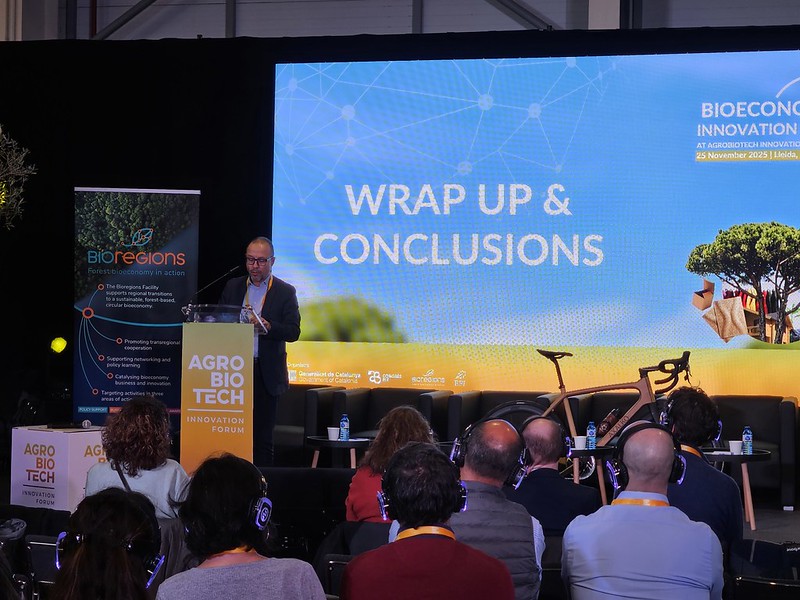
On 25 November, the Bioeconomy Innovation Day 2025, hosted at the AgroBioTech Forum in Lleida, Catalonia, Spain, brought together innovators, industry leaders, investors, and researchers to explore how bio-based materials and circular solutions can drive the biologisation of high-impact sectors such as construction, manufacturing, cosmetics, and interior design.
The programme combined high-level keynotes, sector-focused pitch sessions, and real-time investor feedback after each pitch, creating a dynamic exchange between vision, innovation, and finance.
Opening the event, EFI’s Inazio Martinez de Arano challenged participants with a central question:
“How can we use our existing biomass to deliver both environmental benefits and social value?”
Opening keynotes: regional vision and support for the bioeconomy
Building on this challenge, the opening keynotes set the stage with a strong regional vision for the bioeconomy. Cristina Massot, Secretary General of the Department of Agriculture, Livestock, Fisheries and Food at the Government of Catalonia, outlined how the region is embedding the bioeconomy into long-term economic planning, describing it as “a driving force for the Catalan economy.”
She presented the three-year Bioeconomy Action Plan 2025–2027, equipped with a €269 million budget and 44 actions that prioritise improved forest management, the valorisation of organic and agri-food side-streams, and the creation of resilient agroforestry landscapes. She emphasised that this is now a whole-of-government commitment:
“This is serious. Not only for our department, but also for the Government of Catalonia.”
The second keynote, delivered by BioHubCat and Simbiosy, highlighted the importance of strengthening Catalonia’s support ecosystem for bioeconomy innovation. BioHubCat, Catalonia’s coordination hub for the circular bioeconomy, connects companies with public services, fills system gaps, and helps start-ups overcome technical and administrative challenges.
“Our role is on the ground, helping each company step by step so they can become competitive,” they noted.
Simbiosy, a consultancy specialising in industrial symbiosis and circular economy strategies, stressed that bioeconomy projects are inherently systemic and require collaboration across multiple actors.
They introduced the BioBoost accelerator, which reduces investment risk and supports start-ups with legal, financial, technological, and facilitation services.
“Every systemic project needs facilitation to actually happen,” they emphasised.
Investor panel: market opportunities and the realities of scaling
With a strong regional vision established, the discussion shifted to the financial realities of scaling bio-based innovation. The investor session provided a candid look at the opportunities and challenges facing bio-based ventures.
Michael Brandkamp of the European Circular Bioeconomy Fund stressed that “the bioeconomy is not just an option; it is a must”, driven by shifting consumer demand, policy pressure and climate-related risks.
However, he highlighted key challenges for start-ups, including competition for feedstocks, complex R&D, and the need to validate real customer demand.
“Most innovations fail not because of technology but because they solve a problem nobody has validated,” he remarked.
Jan Debets from META Group emphasised the challenges faced by research-driven ventures, noting that university spin-outs are “high-risk because researchers often fall in love with their science and forget about the customer”.
As a research accelerator, META focuses on helping science-based start-ups navigate this gap between technology and market needs. Debets also highlighted that, as the bio-based sector matures, investors are increasingly open to backing these ventures.
Session 1: Bio-based construction
With these themes in mind, the opening pitch session demonstrated practical ways to apply bio-based construction. It began with a keynote from the Institute for Advanced Architecture of Catalonia (IAAC), where Olly Needham presented their work on full-cycle timber construction.
As a “laboratory for self-sufficient habitat”, they demonstrated how forest stewardship and architecture can be deeply intertwined by managing pine forests, selectively harvesting trees, and ensuring full traceability from woodland to building.
“Traceability is essential if we want to understand the real impact of the materials we use,” he noted, highlighting how their approach connects local forests directly to sustainable buildings.
This keynote was followed by four innovation pitches that highlighted a diverse set of bio-based construction solutions.
ParaStruct presented a carbon-sink subfloor made from mineral binders and plant residues, offering a cost-competitive alternative to cement.
Sebastia showed how locally sourced Pyrenean timber can be turned into cross-laminated timber panels that store carbon effectively and support improved forest management.
RMT Insulation introduced wool- and cotton-based materials for building insulation and green roofs, combining affordability with biodegradability.
Czech University of Life Sciences Prague demonstrated mycelium-based panels made from recycled wood, which provide strong insulation and even help break down contaminants.
Together, the pitches showed how biological materials can advance low-carbon construction while facing shared hurdles such as certification, feedstock availability and scaling.
Session 2: A bio-based way of life
Attention shifted to a bio-based way of life, highlighting innovations that bring sustainability into daily routines and consumer choices. Ricard Armengol, CEO at Provital, opened the second session by unpacking fast-evolving trends in the cosmetics sector, where well-being, scientific evidence, and sustainability increasingly shape consumer expectations. Provital, a global cosmetics ingredient manufacturer based in Catalonia, specialising in natural, sustainable solutions for skin and hair care, stressed that today’s consumers are highly informed and demand transparency: products must not only claim benefits but demonstrate the science behind them. Sustainability, once a niche, is now a dominant driver of innovation.
Provital also highlighted a critical challenge for ingredient suppliers: branding is no longer optional. Even in a B2B context, where raw materials have a limited market, strong branding is essential to avoid being easily substituted.
“If you don’t build a brand, someone else will,” Armengol warned, urging companies to know their customers deeply and tailor products to real needs in a fragmented market.
The pitches showcased how bio-based innovations are entering lifestyle, beauty, and design markets:
Roka Furadada demonstrated how lignin, a widely available forestry by-product, can be upcycled into multifunctional cosmetic actives for skin and hair care, replacing fossil-derived ingredients.
Boreal Bioproducts presented its water-based, zero-waste process for extracting biochemicals from sawdust and bark, producing lignin, tannins, and sugars for applications ranging from cosmetics to animal nutrition.
Bagaceira introduced an acoustic panel system made from sugarcane bagasse, combining aesthetic design with high sound absorption and carbon storage.
All innovators emphasised the circular use of residues, from forestry side-streams to sugarcane by-products, and the growing demand for high-performance, sustainable alternatives in consumer-facing sectors.
Session 3: Bio-based solutions for sustainable manufacturing
The day concluded with a session on manufacturing, the backbone of industrial transformation. A keynote was given by Maria Dolors Nuñez, Head of Technology Opportunity Analysis at ACCIÓ, Catalonia’s agency for business competitiveness and innovation, emphasising that biomaterials are not just part of the solution; they are key enablers for building more sustainable and competitive manufacturing systems.
“Bio-based materials redefine how we design, produce, and reuse,” she noted, positioning them as drivers of innovation and industrial resilience.
Catalonia’s strong ecosystem, spanning research centres, universities, companies, clusters, and institutional support, offers a fertile ground for emerging value chains and industrial symbiosis. However, ACCIÓ stressed that scaling up, securing investment, and harmonising standards remain critical challenges. Linking research with industry and fostering hybrid knowledge across sectors is essential to unlock these opportunities and make Catalonia a European leader in the bioeconomy.
This final session featured innovations in advanced composites and circular materials for mobility, wind energy and urban infrastructures:
Voodin Blade Technology showcased wooden wind turbine blades made from laminated veneer lumber, offering lower cost and carbon impact with a licensing model for scale-up.
Alcorke Playground presented flooring made from upcycled cork stoppers, turning industry waste into renewable playground materials.
Advanced BioComposites (ABC) introduced lightweight biocomposites as strong as aluminium for buses, trains and industrial components, providing recyclable, low-carbon alternatives.
These pitches signal new pathways for renewable materials to reshape manufacturing and reduce environmental impact.
Concluding remarks
The Bioeconomy Innovation Day 2025 underscored a clear message: bio-based materials are no longer niche; they are strategic enablers of sustainability, competitiveness and resilience.
Across keynotes and pitches, speakers highlighted the need for systemic collaboration, strong branding, and new business models to scale innovation. Investors stressed that while policy and consumer trends create momentum, success depends on proving real market demand and bridging the gap between research and commercial viability.
Closing the event, Salvador Samitier of the Department of Agriculture, Livestock, Fisheries and Food at the Government of Catalonia, reminded participants that the bioeconomy is not just a sector but a vision for how society can live with nature. It has the potential to offer economic opportunities, particularly for rural areas, while supporting ecosystem restoration and resilience.
Read all factsheets
Advanced BioComposites (ABC) is a technology company developing sustainable composite materials for industrial manufacturing.
Alcorke Playground is a circular economy project led by the Institut Català del Suro Foundation that gives a second life to used natural cork stoppers.
Voodin Blade Technology develops wind turbine blades using LVL, an alternative to conventional fibreglass and carbon-composite blades.
Roka Furadada specialises in the development of innovative molecules and active ingredients for use in cosmetics and personal care.
Bagaceira develops innovative bio-based materials using sugarcane bagasse, the fibrous residue from sugar and alcohol production.
Boreal Bioproducts is a biorefinery startup that produces bio-based chemical extracts from forest-industry side streams such as sawdust and bark.
RMT Insulation develops natural insulation solutions using renewable natural fibres as alternatives to synthetic materials.
This innovation focuses on producing mycelium-based biocomposite (MBB) insulation panels using waste wood as the primary feedstock.
Sebastia is a timber construction company with roots in a family wood-working tradition dating back to 1954.
ParaStruct works to decarbonise the construction industry by applying circular economy principles to building materials.
Explore the innovations presented at the Bioeconomy Innovation Day 2025 in a factsheet format.
The Forestry Hub of Catalonia is an initiative supporting innovation in forestry value chains. Its facilities for research, development, transfer, facilitation and training focus on using wood for: construction, textiles and biochemistry, aromatic and medicinal plants for pharma and cosmetics, and truffles and other non-wood forest products (NWFP) for food.
For some time now, the mantra has been circulating that our forests do not produce high-quality wood suitable for making splinters. But this is not true. It is also useful for other uses, such as the construction of wooden houses. A key point to increase forest management, which is expensive and difficult for owners to assume if they do not get a return on it.
“And forestry, management, has proven to be one of the most powerful tools to transform the landscape and fight against the impacts of climate change, such as droughts.” This is explained by Mario Beltran, a technician at the Centre for Forest Science and Technology of Catalonia (CTFC).
The pines that they have removed after managing in a forest in Llobera, in the Solsonès region, are taken to the Olius Forest Hub, a few kilometres away. It is a laboratory that conducts tests and trials on wood, but on an industrial scale. Thus, “we can give the construction recipes with different types of wood to the industry because we have tried it before here.”
The building is 1,200 square meters. And it is built, obviously, with wood, with fir and black pine from the Pyrenees. When we enter, the temperature is comfortable, although they do not have heating. Wood acts as a thermal insulator.
In the warehouse, the machines manufacture structural panels. They have combined different Mediterranean woods, such as Aleppo pine and beech, which are very resistant, but which have never been used in construction.
Wildfires, pests, diseases, drought, and climate change are putting pressure on natural ecosystems. To address these challenges, it is necessary to develop sustainable landscapes that are more resilient.
Until now, five pilot projects have been developed. The first of which was carried out in 2023 in the municipality of Soriguera, in Pallars Sobirà. In 2024, three more pilots were launched in Terres de l’Ebre, the Camprodon Valley in Ripollès, and the Carme Valley in Anoia. The fifth pilot is in Cerdanya.
Its primary objective is to promote collaborative projects that strengthen the resilience of agroforestry landscapes throughout Catalonia, enabling these territories to better adapt to social, economic, and environmental challenges.
The programme places a strong emphasis on multi-sectoral collaboration, participatory approaches, and stimulating local value creation. Among its fundamental goals are the development of multifunctional landscapes, the enhancement of ecosystem health and biodiversity, and support for the local bioeconomy, as well as the promotion of innovation within rural areas.
It is open to associations, cooperatives, small and medium-sized enterprises, local entities, and social economy organisations in the region. Each approved project must bring together at least four entities representing different sectors and formalise their cooperation through the creation of an “activating committee” responsible for coordinating actions and ensuring integrative, strategic management to address the challenges involved.
The projects will have a duration of three years, spanning the period 2026–2028, with a total budget allocation of €3 million.
The call for applications is expected to open before the end of this year. The size of the projects must cover at least 5,000 hectares and two municipalities. This program is promoted within the framework of the Bioeconomy Strategy of Catalonia 2030.
Featured image: imv from Getty Images Signature / edited in Canva
You can now explore the full report in an audio format. Press play to hear the content narrated from start to finish. In addition, we invite you to take a quick survey to share your experience – this will help us improve our future reports. Answer our survey.
Public procurement is one of the most powerful tools governments have to shape markets and accelerate change. By integrating bio-based thinking into existing green public procurement (GPP) frameworks, public authorities can directly support climate goals, strengthen regional economies, and cut dependence on fossil-based inputs. Bio-based solutions, made from renewable resources, offer practical alternatives that directly help reduce emissions, close material loops, and replace virgin raw materials with circular ones.
At the bio-based public procurement training held in Barcelona, Spain, on 4 June 2025, co-organised by the Bioregions Facility and the Government of Catalonia, experts from the Province of Zeeland joined Catalan institutions to share practical experiences and strategies. The following six insights reflect what emerged from their combined perspectives:
Key Insights
Political will: Political leadership sets the mandate for procurement teams to prioritise sustainability and support the bioeconomy.
Early collaboration: Engaging all relevant stakeholders early in the process helps prevent delays and leads to more effective and sustainable outcomes.
Tools and training: The right tools, data, and training empower procurement teams to apply sustainability criteria with consistency and ease.
Pilot projects: Pilots provide space to test innovative materials and methods while building trust and learning from experience.
Monitoring: Measuring progress before, during, and after projects ensures impact is real, not just stated.
Innovative legal pathways: Adaptive legal frameworks make it possible to test new approaches without fear of procedural penalties.
1. Political Will Turns Goals into Action
Core idea: Political will is the foundation for scaling bio-based procurement. It provides the leadership, resources, and space for innovation needed to align procurement with broader sustainability goals. When this commitment is reflected across public administrations, from high-level strategies to operational decisions, it enables a consistent and coordinated shift toward sustainable procurement practices.
Example:
In Zeeland, the “Comply or Explain” policy requires suppliers to choose sustainable materials by default. If they cannot, they must formally justify their choice. This creates a cultural shift where bio-based and circular solutions become the default, not the exception.
Catalonia’s Green Public Procurement Action Plan (2022–2025) demonstrates strong political and administrative will, with a clear target of reaching 50% green contracts. Surpassing this goal with 67% shows how defined objectives, backed by leadership, can support lasting implementation.
2. Early Collaboration Leads to Effective Implementation
Core idea: Bringing key stakeholders together early improves both the process and the outcomes. Bio-based procurement often requires new specifications, supplier adjustments, or legal clarifications. Starting the conversation late creates delays and missed opportunities.
Example:
In Catalonia, early coordination on public construction projects between the housing corporation, architects and the construction company led to smoother tendering, faster delivery, and better sustainability performance.
In Zeeland, efforts focused on connecting actors across the value chain, recognising that much of the environmental impact begins early in production. By engaging primary producers and supporting them to meet sustainability requirements, the region ensured upstream alignment and more effective, life cycle-based procurement.
Zeeland also ensured early collaboration with asset owners, who play a key role in decision-making. Involving them from the start helped align priorities and made sustainable procurement outcomes more feasible and effective.
3. Tools and Training Bridge the Gap Between Policy and Practice
Core idea: Procurement teams need hands-on tools and clear guidance to act on sustainability goals; policy alone is not enough. Clear methodologies, databases, and training programmes build internal capacity and reduce resistance to change, especially when teams face unfamiliar product categories like bio-based materials.
Example:
The province of Zeeland created an online database featuring over 1,500 verified bio-based products, reviewed by an independent commission to prevent greenwashing. This platform helps buyers and suppliers identify what is available on the market and makes it easier to incorporate bio-based alternatives into procurement.
Zeeland also developed the Sustainable Procurement Impact Tool, which enables procurement staff and suppliers to calculate the environmental impact of tenders, including reductions in CO₂ emissions and the use of non-renewable raw materials.
In Catalonia, the government supports implementation through structured training programmes and practical tools that help procurement teams apply environmental criteria systematically, including sector-specific guidance, contract templates, and technical resources.
4. Pilot Projects Create Space to Learn and Improve
Core idea: Pilots are an essential part of scaling sustainable procurement. They allow public authorities to test new materials, methods, and partnerships in a controlled, lower-risk setting. Importantly, the value of a pilot is not just in the outcome but in what gets shared. Whether the results are successful or mixed, transparent reporting helps others learn and adapt faster. Normalising experimentation (and even failure) is part of accelerating innovation.
Example:
Zeeland piloted a wide range of bio-based materials in public infrastructure, including signage made from natural fibres and asphalt using lignin from the paper industry. Some pilots proved cost-effective and scalable, while others faced technical setbacks. One key learning was that bio-based solutions often require different types of maintenance and long-term planning. By monitoring performance over time and involving maintenance teams early in the process, the province was able to better anticipate needs across the full life cycle. Sharing both successes and challenges helped refine their procurement approach and offered valuable lessons to other regions.
5. Monitoring Makes Procurement Accountable
Core idea: Measuring and communicating impact is essential to make sustainability visible and credible. Monitoring should begin at the planning stage, continue through implementation, and conclude with a clear evaluation of results. It allows organisations to compare performance, share progress, and engage others more effectively. The key is to start with simple, realistic goals and support them with clear, measurable criteria.
Example:
In Catalonia, monitoring efforts currently focus on tracking the number of tenders that include environmental criteria. While this is a useful starting point for understanding the uptake of green procurement, it does not yet capture the actual environmental impact of purchases.
In Zeeland, the Sustainable Procurement Impact Tool1 supports project teams in setting and tracking measurable targets, such as CO₂ reductions and lower use of primary raw materials. The tool uses SDG-based indicators to align with broader policy goals and communicate progress in a language familiar to both policymakers and the public. Results are collected before, during, and after the project, then integrated into annual reporting and budgeting. This makes performance comparable across projects and helps embed sustainability into routine decision-making.
1. If you would like to learn more about this tool, please reach out to mail @ mviplatform.nl.
6. Innovative Legal Pathways Can Enable Sustainable Procurement
Core idea: Scaling sustainable and bio-based procurement requires an innovative legal environment that supports experimentation. Without space to test new approaches, rigid rules and risk-averse interpretations can prevent even the most ambitious policies from becoming practical action. Legal frameworks and internal legal teams need to enable, not block, innovation.
Example:
In Barcelona, the municipal housing corporation has used innovation-friendly procurement rules (supported by the EU’s guidance on innovation procurement) to favour environmental performance over the lowest cost. This legal strategy embeds sustainability as a key criterion in public housing tenders, backed by strong political will. But as these methods become widespread, it remains to be seen if they are compatible with standard procurement procedures. The example underscores the need to adapt legal frameworks, so sustainability continues as a central focus beyond the initial innovation phase.
During the training, participants emphasised the need for a regulatory sandbox, a controlled setting where procurement teams can safely test new methods. This sandbox would let authorities pilot innovative solutions, refine them through feedback, and scale successful models without compliance risks or procedural delays. It also helps reveal practical win–wins. For instance, one hospital’s switch to bio-based packaging tape not only reduced fossil-derived materials but also made recycling easier and faster for staff, a small yet valuable operational and environmental improvement.
Case Study 1: Zeeland’s Bio-asphalt Pilot
The Province of Zeeland tested a new form of asphalt where 50% of the traditional fossil-based binder was replaced with lignin, a bio-based by-product from the paper industry. The pilot aimed to reduce carbon emissions in road construction by using bio-based materials.
Although the bio-asphalt was about 20% more expensive and lasted seven years compared to the typical twelve, it was considered a success for a first trial. The project provided concrete data on performance and cost, offering a strong foundation for optimising future tenders and scaling bio-based materials more effectively. It also underscored the importance of political backing, where strong support from the province for innovation made the pilot possible.
Translation of sign: Sustainability, Zeeland style. You’re driving on bio-asphalt. We’re paving the way to lower CO₂ emissions.
Credit: Province Zeeland
Case study 2: Bio-based Social Housing Projects in Catalonia
As part of the training, participants visited two completed social housing projects developed by IMHAB, Barcelona’s public housing agency. Built with cross-laminated timber and bio-based insulation, the buildings demonstrate how bio-based solutions can meet high-performance standards. They feature A-rated energy performance, aerothermal systems, solar panels, and rooftop vegetation.
These projects reflect key principles of effective bio-based public procurement, including early collaboration, political commitment, and a willingness to test innovative materials and methods. Crucially, they also show that when tenders include clear and ambitious criteria for environmental impact and construction time (see graph below), bio-based solutions such as wood often emerge naturally as the most viable response. Delivered through a collaborative design-and-build model, the projects reduced construction time by over 30% and exemplify how public procurement can drive circular practices and lead by example.
One of IMHAB’s completed bio-based social housing projects in Barcelona
Final Thought
Embedding bio-based thinking into green public procurement is not about adding complexity; it is about aligning systems to deliver on climate, circularity, and regional development goals. Catalonia and Zeeland show that with political support, collaboration, the right tools, and strong monitoring, public procurement can become a powerful driver of change.
9th Spanish Forestry Congress 2025 (9º Congreso Forestal Español)
On 16–20 June, join the 9th Spanish Forestry Congress (CFE) in Gijón, Spain. It is the most significant event organised by the Spanish Society of Forest Sciences (SECF) and organised by SECF, the Government of the Principality of Asturias, the City Council of Gijón, the Ministry for Ecological Transition of the Spanish Government, the Demographic Challenge (MITECO) and the University of Oviedo.
Held every four years, it brings together researchers, technical staff, owners and professionals in forest management and industry for a week.
The primary objective of the CFE is to showcase the findings of research and case studies in forestry science and techniques that have emerged between each Congress. It facilitates analysis and debate to generate novel concepts and proposals to enhance forest management practices, and to align policy with societal interests.
This dossier outlines the findings and opportunities presented by the LIFE BIOREFFORMED project (2019-2024), which explores the potential of utilising forest biomass in biorefinery processes. It highlights the benefits of enhancing forest management and contributing to a sustainable bioeconomy.
In addition, it emphasizes the transformative potential of forest biomass in fostering a sustainable bioeconomy while enhancing forest resilience and contributing to climate change mitigation. It serves as a guide for stakeholders in forestry, bioeconomy, and policymaking.
Content: Use of Forest Biomass in Biorefinery Processes: A Technical Dossier
The Forest Climate Credit System of Catalonia (SCCFC), developed as part of the LIFE CLIMARK project, aims to address climate change through sustainable forest management. It operates using Forest Mitigation and Adaptation Projects (PROMACC), which generate climate credits based on their impact on carbon regulation, water provision, and biodiversity enhancement. Public or private entities can purchase these credits.
This system showcases an integrated model for mitigating climate change while supporting biodiversity and water resources. It is a replicable blueprint for other regions aiming to align sustainable forest management with ecosystem restoration and climate policies.
Content: Manual for the Climate Credit System of Catalonia
Publisher: Forest Property Center, Directorate General for Climate Change and Environmental Quality
We use cookies to optimize our website and our service.
Funcional
Always active
The technical storage or access is strictly necessary for the legitimate purpose of enabling the use of a specific service explicitly requested by the subscriber or user, or for the sole purpose of carrying out the transmission of a communication over an electronic communications network.
Preferences
The technical storage or access is necessary for the legitimate purpose of storing preferences that are not requested by the subscriber or user.
Statistics
The technical storage or access that is used exclusively for statistical purposes.The technical storage or access that is used exclusively for anonymous statistical purposes. Without a subpoena, voluntary compliance on the part of your Internet Service Provider, or additional records from a third party, information stored or retrieved for this purpose alone cannot usually be used to identify you.
Marketing
The technical storage or access is required to create user profiles to send advertising, or to track the user on a website or across several websites for similar marketing purposes.