
Our work > Policy
Bioeconomy Regions Summit 2025
Developing a sustainable and circular bioeconomy is one of the most impactful tools that Europe can leverage to address pressing challenges. The Bioeconomy Regions Summit is a place to explore solutions for European regions to advance in the forest bioeconomy.
Bioeconomy Regions Summit 2025
While different regions are developing their own bioeconomy pathways, they often encounter similar challenges. Therefore, increased inter-regional collaboration can accelerate mutual learning, support the shared use of resources, and, importantly, make EU initiatives and policy tools work for regions.
The Bioeconomy Regions Summit 2025 will explore regional bioeconomy solutions for EU policy ambitions.
Objectives
- Advance understanding of the role of regions in the circular bioeconomy: Engage regional governments, EU institutions, and other bioeconomy stakeholders to learn from the work regions are undertaking to drive the green transition through the bioeconomy.
- Knowledge exchange: Facilitate the exchange of best practices and strategies between regions on the design, implementation, collaboration and financing of bioeconomy initiatives, with a specific focus on implementing key EU policy initiatives.
- Networking and collaboration: Foster networking among bioeconomy stakeholders, including regional representations to the EU and bioeconomy networks, to forge long-lasting collaboration across European regions.
Target audience
- High-level political representatives from leading bioeconomy regions, including representatives from member regions in the Committee of Regions (CoR)
- European Commission representatives
- Members of the European Parliament
- Regional delegations to the EU
- Bioeconomy networks
- Representatives of regional innovation agencies, bioeconomy-related clusters, and other key actors active at the regional level
- Other bioeconomy stakeholders


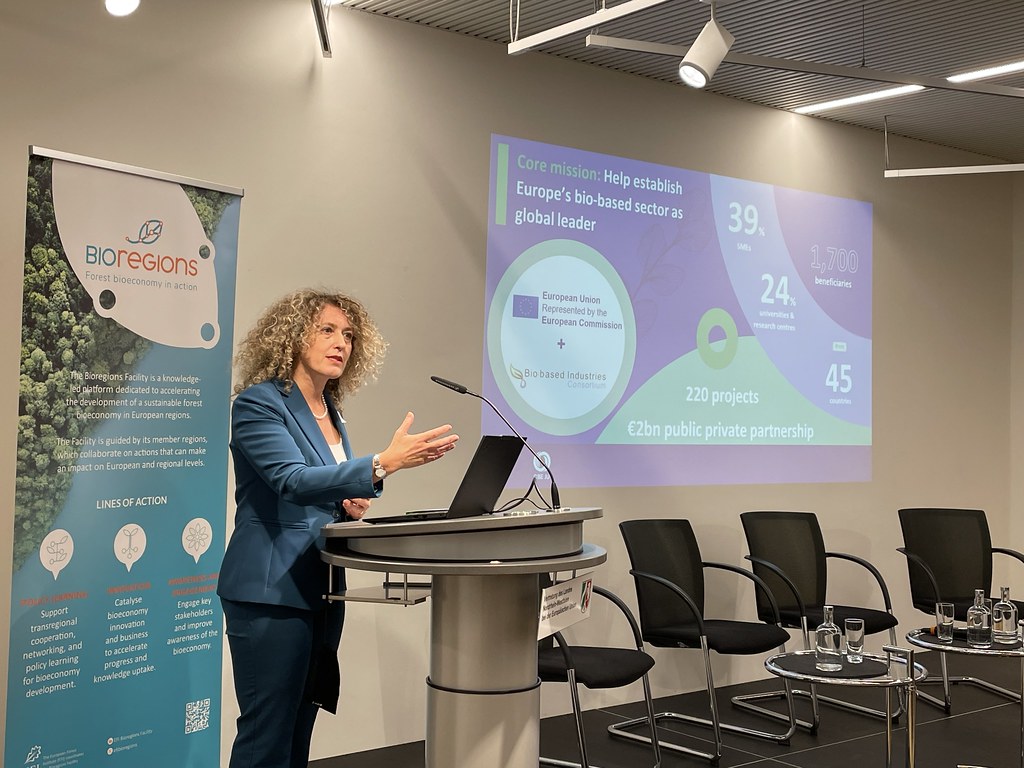
Photos




Presentations


Programme
Time CET

Silke Gorißen, Minister of Agriculture and Consumer Protection

Cristina Massot, Secretary General of the Department of Agriculture, Livestock, Fisheries and Food, Catalonia

José Almodóvar Aráez, Deputy Minister of the Environment, Castilla-La Mancha

Virginia Puzzolo, Head of Programme, CBE JU

Kirill Dimanopoulos, Project Adviser, European Innovation Council and SMEs Executive Agency

Bart Muys, Full Professor and Head of Forest, Nature and Landscape Unit, KU Leuven

Lars Kristian Selbekk, Halden River Sub-district Manager

Bart Meuleman, Project Manager, NatuurInvest

Valentino Marini Govigli, Assistant Professor, Department of Agricultural and Food Sciences, University of Bologna

Sven Wydra, Head of Business Unit Bioeconomy and Life Sciences, Fraunhofer Institute for Systems and Innovation Research

Angèle Liaigre, Senior EU Advisor for Cities Northern Netherlands

Markku Pyykkönen, Marketing Director, City of Joensuu

Anne Kokkonen, Project Manager, City of Joensuu

Gorka Altuna, Head of Development of Bioeconomy Projects, HAZI

Silke Gorißen
Minister of Agriculture and Consumer Protection, North Rhine-Westphalia, Germany


Kirill Dimanopoulos
Project Adviser, European Innovation Council and SMEs Executive Agency (EISMEA)


Venue
See you in Brussels
Representation of North Rhine-Westphalia to EU venue, Brussels, Belgium
Rue Montoyer 47, 1000 Bruxelles, Belgium
Organisers


In collaboration with


BIO2REG
BIO2REG supports regions in Europe that are shaped by greenhouse gas-intensive industries such as coal, agriculture, forestry, or fisheries in their transition toward a sustainable circular bioeconomy. The project takes a systemic approach: beyond developing bio-based and circular value chains, it also addresses education, social aspects, innovation ecosystems, living labs and research infrastructures. By linking bioeconomy measures to regional development priorities, BIO2REG helps stakeholders identify and implement solutions that are relevant in their own context. Through practical tools, best practice guides, and self-assessment frameworks, complemented by a regions-to-regions network and an exchange instrument, stakeholders can strengthen capacity and foster collaboration to support the green transition.
Vanguard Initiative
The Vanguard Initiative is a network of 33 regional governments from 14 countries across Europe working together through interregional cooperation and joint investments. It focuses on innovative place-based thematic areas where there is political commitment to support regional clusters, including the bioeconomy. The Vanguard Initiative has developed its own interregional funding instrument (Vinnovate) to support high TRL interregional projects in its eight focus areas, while also engaging with EU policymakers on interregional innovation tools.
ERRIN
The European Regions Research and Innovation Network (ERRIN) is a Brussels-based platform that gathers around 120 regional organisations from more than 20 European countries. Established in 2001, ERRIN supports members in enhancing their regional and local research and innovation capacities and further developing their R&I ecosystems. ERRIN members engage in 12 Working Groups and two Task Forces, addressing thematic areas and cross-cutting policy priorities. Among them, ERRIN’s Bioeconomy Working Group strengthens regional influence in shaping Europe’s circular bioeconomy, while also focusing on the Horizon Europe Mission Soil. The group covers a wide range of bioeconomy topics such as food systems, soil health, forestry, bioenergy, biowaste, and bio-based products.
ACR+
The Association of Cities and Regions for sustainable Resource management (ACR+) is an international network of local and regional authorities and other stakeholders working on material resources and the circular economy. For more than 30 years, ACR+ has provided its members with concrete tools, technical data, and opportunities to exchange good practices. Given the crucial role that cities and regions play in fostering the transition to circular biobased economies, the bioeconomy is one of the key areas of interest for ACR+ members. In this context, the association provides them support for building capacity and expertise on circular bioeconomy through good practice sharing and practical guidance.
Explore all Bioeconomy Regions Summits


Supported by Bioregions members


