
Bioeconomy Innovation Day 2025: advancing bio-based innovation across key sectors


On 25 November, the Bioeconomy Innovation Day 2025, hosted at the AgroBioTech Forum in Lleida, Catalonia, Spain, brought together innovators, industry leaders, investors, and researchers to explore how bio-based materials and circular solutions can drive the biologisation of high-impact sectors such as construction, manufacturing, cosmetics, and interior design.
The programme combined high-level keynotes, sector-focused pitch sessions, and real-time investor feedback after each pitch, creating a dynamic exchange between vision, innovation, and finance.
Opening the event, EFI’s Inazio Martinez de Arano challenged participants with a central question:
“How can we use our existing biomass to deliver both environmental benefits and social value?”

Opening keynotes: regional vision and support for the bioeconomy
Building on this challenge, the opening keynotes set the stage with a strong regional vision for the bioeconomy. Cristina Massot, Secretary General of the Department of Agriculture, Livestock, Fisheries and Food at the Government of Catalonia, outlined how the region is embedding the bioeconomy into long-term economic planning, describing it as “a driving force for the Catalan economy.”
She presented the three-year Bioeconomy Action Plan 2025–2027, equipped with a €269 million budget and 44 actions that prioritise improved forest management, the valorisation of organic and agri-food side-streams, and the creation of resilient agroforestry landscapes. She emphasised that this is now a whole-of-government commitment:
“This is serious. Not only for our department, but also for the Government of Catalonia.”
The second keynote, delivered by BioHubCat and Simbiosy, highlighted the importance of strengthening Catalonia’s support ecosystem for bioeconomy innovation. BioHubCat, Catalonia’s coordination hub for the circular bioeconomy, connects companies with public services, fills system gaps, and helps start-ups overcome technical and administrative challenges.
“Our role is on the ground, helping each company step by step so they can become competitive,” they noted.
Simbiosy, a consultancy specialising in industrial symbiosis and circular economy strategies, stressed that bioeconomy projects are inherently systemic and require collaboration across multiple actors.
They introduced the BioBoost accelerator, which reduces investment risk and supports start-ups with legal, financial, technological, and facilitation services.
“Every systemic project needs facilitation to actually happen,” they emphasised.

Investor panel: market opportunities and the realities of scaling
With a strong regional vision established, the discussion shifted to the financial realities of scaling bio-based innovation. The investor session provided a candid look at the opportunities and challenges facing bio-based ventures.
Michael Brandkamp of the European Circular Bioeconomy Fund stressed that “the bioeconomy is not just an option; it is a must”, driven by shifting consumer demand, policy pressure and climate-related risks.
However, he highlighted key challenges for start-ups, including competition for feedstocks, complex R&D, and the need to validate real customer demand.
“Most innovations fail not because of technology but because they solve a problem nobody has validated,” he remarked.
Jan Debets from META Group emphasised the challenges faced by research-driven ventures, noting that university spin-outs are “high-risk because researchers often fall in love with their science and forget about the customer”.
As a research accelerator, META focuses on helping science-based start-ups navigate this gap between technology and market needs. Debets also highlighted that, as the bio-based sector matures, investors are increasingly open to backing these ventures.
Session 1: Bio-based construction
With these themes in mind, the opening pitch session demonstrated practical ways to apply bio-based construction. It began with a keynote from the Institute for Advanced Architecture of Catalonia (IAAC), where Olly Needham presented their work on full-cycle timber construction.
As a “laboratory for self-sufficient habitat”, they demonstrated how forest stewardship and architecture can be deeply intertwined by managing pine forests, selectively harvesting trees, and ensuring full traceability from woodland to building.
“Traceability is essential if we want to understand the real impact of the materials we use,” he noted, highlighting how their approach connects local forests directly to sustainable buildings.
This keynote was followed by four innovation pitches that highlighted a diverse set of bio-based construction solutions.
- ParaStruct presented a carbon-sink subfloor made from mineral binders and plant residues, offering a cost-competitive alternative to cement.
- Sebastia showed how locally sourced Pyrenean timber can be turned into cross-laminated timber panels that store carbon effectively and support improved forest management.
- RMT Insulation introduced wool- and cotton-based materials for building insulation and green roofs, combining affordability with biodegradability.
- Czech University of Life Sciences Prague demonstrated mycelium-based panels made from recycled wood, which provide strong insulation and even help break down contaminants.
Together, the pitches showed how biological materials can advance low-carbon construction while facing shared hurdles such as certification, feedstock availability and scaling.
Session 2: A bio-based way of life
Attention shifted to a bio-based way of life, highlighting innovations that bring sustainability into daily routines and consumer choices. Ricard Armengol, CEO at Provital, opened the second session by unpacking fast-evolving trends in the cosmetics sector, where well-being, scientific evidence, and sustainability increasingly shape consumer expectations. Provital, a global cosmetics ingredient manufacturer based in Catalonia, specialising in natural, sustainable solutions for skin and hair care, stressed that today’s consumers are highly informed and demand transparency: products must not only claim benefits but demonstrate the science behind them. Sustainability, once a niche, is now a dominant driver of innovation.
Provital also highlighted a critical challenge for ingredient suppliers: branding is no longer optional. Even in a B2B context, where raw materials have a limited market, strong branding is essential to avoid being easily substituted.
“If you don’t build a brand, someone else will,” Armengol warned, urging companies to know their customers deeply and tailor products to real needs in a fragmented market.
The pitches showcased how bio-based innovations are entering lifestyle, beauty, and design markets:
- Roka Furadada demonstrated how lignin, a widely available forestry by-product, can be upcycled into multifunctional cosmetic actives for skin and hair care, replacing fossil-derived ingredients.
- Boreal Bioproducts presented its water-based, zero-waste process for extracting biochemicals from sawdust and bark, producing lignin, tannins, and sugars for applications ranging from cosmetics to animal nutrition.
- Bagaceira introduced an acoustic panel system made from sugarcane bagasse, combining aesthetic design with high sound absorption and carbon storage.
All innovators emphasised the circular use of residues, from forestry side-streams to sugarcane by-products, and the growing demand for high-performance, sustainable alternatives in consumer-facing sectors.
Session 3: Bio-based solutions for sustainable manufacturing
The day concluded with a session on manufacturing, the backbone of industrial transformation. A keynote was given by Maria Dolors Nuñez, Head of Technology Opportunity Analysis at ACCIÓ, Catalonia’s agency for business competitiveness and innovation, emphasising that biomaterials are not just part of the solution; they are key enablers for building more sustainable and competitive manufacturing systems.
“Bio-based materials redefine how we design, produce, and reuse,” she noted, positioning them as drivers of innovation and industrial resilience.
Catalonia’s strong ecosystem, spanning research centres, universities, companies, clusters, and institutional support, offers a fertile ground for emerging value chains and industrial symbiosis. However, ACCIÓ stressed that scaling up, securing investment, and harmonising standards remain critical challenges. Linking research with industry and fostering hybrid knowledge across sectors is essential to unlock these opportunities and make Catalonia a European leader in the bioeconomy.
This final session featured innovations in advanced composites and circular materials for mobility, wind energy and urban infrastructures:
- Voodin Blade Technology showcased wooden wind turbine blades made from laminated veneer lumber, offering lower cost and carbon impact with a licensing model for scale-up.
- Alcorke Playground presented flooring made from upcycled cork stoppers, turning industry waste into renewable playground materials.
- Advanced BioComposites (ABC) introduced lightweight biocomposites as strong as aluminium for buses, trains and industrial components, providing recyclable, low-carbon alternatives.
These pitches signal new pathways for renewable materials to reshape manufacturing and reduce environmental impact.
Concluding remarks
The Bioeconomy Innovation Day 2025 underscored a clear message: bio-based materials are no longer niche; they are strategic enablers of sustainability, competitiveness and resilience.
Across keynotes and pitches, speakers highlighted the need for systemic collaboration, strong branding, and new business models to scale innovation. Investors stressed that while policy and consumer trends create momentum, success depends on proving real market demand and bridging the gap between research and commercial viability.
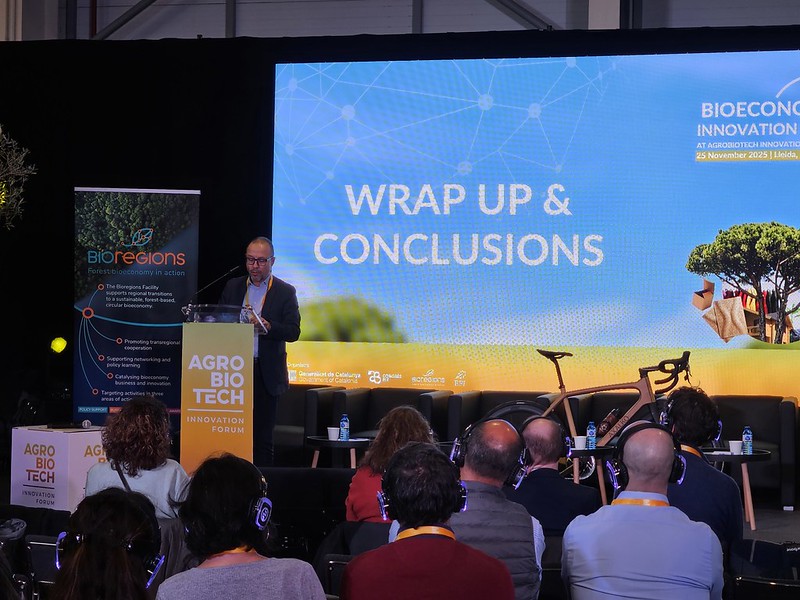
Closing the event, Salvador Samitier of the Department of Agriculture, Livestock, Fisheries and Food at the Government of Catalonia, reminded participants that the bioeconomy is not just a sector but a vision for how society can live with nature. It has the potential to offer economic opportunities, particularly for rural areas, while supporting ecosystem restoration and resilience.
Read all factsheets


